

Blog
IBC Tote Dimensions, Weight & Capacity (275 vs 330 Gallon)

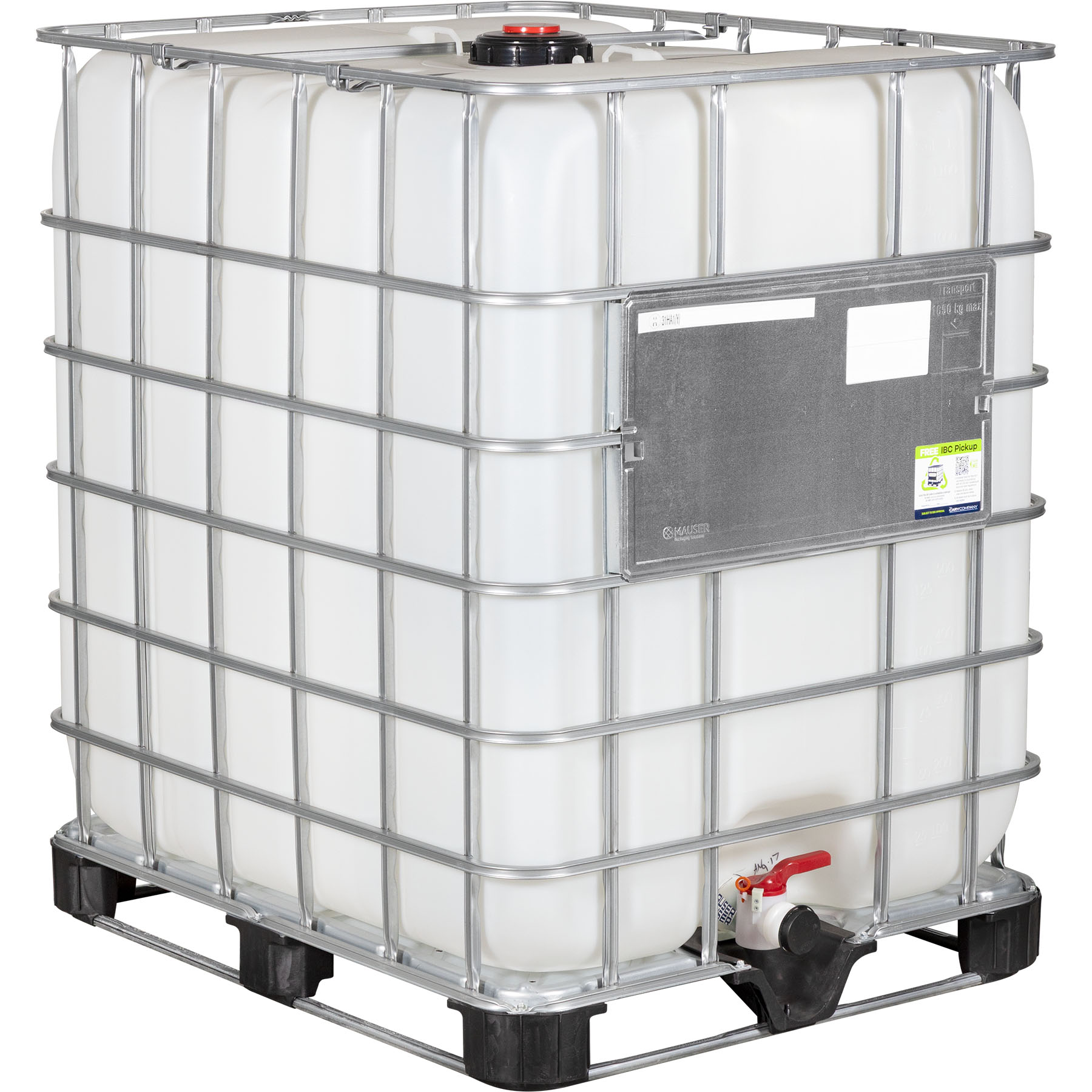
IBC tote dimensions are about 48″ long by 40″ wide for both standard sizes, the same footprint as a common US pallet. A 275 gallon tote typically stands around 45 to 46 inches tall and a 330 gallon tote around 53 to 54 inches. Empty, most caged totes weigh roughly 125 to 160 lb.
Those are the numbers most people need when planning a warehouse aisle, a truck bed or a rainwater setup. The rest of this guide covers what changes the measurements (pallet style, cage or no cage, valve type), how to work out a full tote’s weight, and what to double-check on the product page before you order.
IBC Tote Dimensions at a Glance
The table below uses typical figures for new and reconditioned caged totes on a standard pallet. Individual models vary by an inch or two, so treat it as a planning guide and confirm the exact specs listed on each product.
| Spec | 275 Gallon Tote | 330 Gallon Tote |
|---|---|---|
| Footprint (L x W) | About 48″ x 40″ | About 48″ x 40″ |
| Height | About 45 to 46″ | About 53 to 54″ |
| Capacity in liters | About 1,040 L (often sold as “1,000 L”) | About 1,250 L |
| Empty weight (caged) | Roughly 125 to 140 lb | Roughly 140 to 160 lb |
| Full of water (approx.) | About 2,400 lb | About 2,900 lb |
| Top opening | Usually a 6″ screw cap | Usually a 6″ screw cap |
| Bottom outlet | Usually a 2″ valve | Usually a 2″ valve |
For reference, our new 275 gallon IBC tote with a 2″ camlock valve lists external dimensions of about 47.25″ x 39.25″ x 45.5″, and the new 330 gallon IBC tote with a camlock valve lists 48″ x 40″ x 54″ and 155 lb.
Why Almost Every IBC Tote Is 48″ x 40″
The 48″ x 40″ footprint matches the most common pallet size in North America. A tote therefore moves on the same forklifts, pallet jacks, racking and trailer layouts as everything else in a typical warehouse. Many composite and steel pallets allow four-way forklift entry, while some plastic and wood pallets are two-way only, so check the pallet style if you need to pick it up from the side.
Because the footprint stays the same, the real difference between the two common sizes is height. A 330 gallon tote gets its extra 55 gallons by standing roughly 8 inches taller, not by taking up more floor.
Inside vs. Outside Measurements
An IBC tote is a plastic bottle (usually HDPE) sitting inside a steel cage on a pallet. Published dimensions are almost always the outside measurements of the whole unit. A few details worth knowing:
- The bottle is smaller than the cage. Some listings give a separate “inner receptacle” size. You only need it if you’re building a cover, an insulation wrap or a custom frame.
- The valve sticks out. The bottom discharge valve sits at the front and can add a few inches to the length. Leave room to attach a hose or camlock fitting.
- The fill cap adds height. On some models the 6″ top cap sits slightly above the cage. Allow headroom to open it and insert a fill hose or pump.
- Pallet type changes height. Steel, composite, plastic and wood pallets are not all the same thickness, which is why two “275 gallon” totes can differ by an inch or more.
Caged vs. Cageless Tote Dimensions
Cageless totes use a thicker, self-supporting bottle instead of a steel frame, and their measurements differ from standard caged totes. Our 275 gallon CageBuster plastic IBC tote lists about 42″ x 48″ x 54″, and the 330 gallon CageBuster plastic IBC tote lists about 42″ x 48″ x 59″. If you’re fitting cageless totes into a tight space or a rack, plan around those figures rather than the standard 48″ x 40″.
How Much Does an IBC Tote Weigh?
Empty weight
A typical caged 275 gallon tote weighs somewhere around 125 to 140 lb empty, and a 330 gallon tote around 140 to 160 lb. Steel pallets weigh more than plastic or composite ones, and cageless designs can be heavier than you’d expect because the bottle walls are thicker. Each product page lists the weight for that specific tote.
Full weight
To estimate a full tote, multiply the gallons by the weight of one gallon of your liquid, then add the empty weight. Water weighs about 8.34 lb per gallon, so:
- 275 gallons of water: 275 x 8.34 is about 2,294 lb. Add the tote and you’re at roughly 2,400 to 2,450 lb.
- 330 gallons of water: 330 x 8.34 is about 2,752 lb. Add the tote and you’re near 2,900 lb.
Denser liquids push those numbers up fast. If your product has a specific gravity above 1.0, multiply the water weight by that figure. UN-rated totes are marked with a maximum specific gravity and permissible gross mass, so check those markings or the product page before filling a tote with anything heavier than water.
Capacity: Gallons, Liters and Smaller Sizes
One US gallon is about 3.785 liters. That makes a 275 gallon tote roughly 1,040 liters, which is why it’s often called a “1,000 liter IBC,” and a 330 gallon tote roughly 1,250 liters. Totes are usually filled a little short of brim capacity to leave headspace for expansion, so usable volume can be slightly less than the nameplate number.
If 275 gallons is more than you need, half-height totes exist too. Our 135 gallon IBC tote with a 2″ NPT valve keeps the 48″ x 40″ footprint at roughly half the height. For smaller volumes still, drums are easier to move by hand; see how many gallons are in a drum for standard drum sizes.
Planning Space for an IBC Tote
Before you order, measure the spot where the tote will live and the path it takes to get there.
- Doorways. A 40″ wide tote won’t pass through a standard 32″ or 36″ interior door. Plan for a garage door, loading dock or double door.
- Floor load. A full 330 gallon water tote puts close to 1.5 tons on a 48″ x 40″ area. A concrete slab is usually fine; wooden decks, trailers and mezzanines need checking.
- Stacking. Many totes are built to stack, but only within the stacking load listed for that model. Never stack on damaged cages or uneven ground.
- Outdoor use. Sunlight degrades natural HDPE over time and encourages algae in stored water. A UV-protected tote such as our 275 gallon gray IBC tote with UV protection, or a tote cover, helps.
- Valve access. Keep the front clear and raise the tote enough to get a bucket or hose under the valve if you plan to drain by gravity.
Which Size Fits Your Space?
If height is the constraint, such as under a low shelf, inside a van or beneath a downspout, the 275 gallon tote is the safer fit. If floor space is tight but you have overhead room, the 330 gallon tote holds 20% more liquid on the same footprint. For a full side-by-side on cost, handling and use cases, read 275 vs 330 gallon IBC tote: which should you buy?
Ready to compare models? Browse all IBC totes, including new, rebottled and reconditioned options, or see our plastic drums and barrels if you need something smaller.
Frequently Asked Questions
What are the dimensions of a 275 gallon IBC tote?
A typical 275 gallon IBC tote is about 48 inches long, 40 inches wide and 45 to 46 inches tall, pallet included. Exact measurements vary slightly by pallet and cage style, so check the specs on the individual product page.
How tall is a 330 gallon IBC tote?
Most caged 330 gallon totes are about 53 to 54 inches tall on the same 48 x 40 inch footprint as a 275 gallon tote. Cageless 330 gallon models can be taller, around 59 inches.
How much does a full 275 gallon tote of water weigh?
Roughly 2,400 lb. Water weighs about 8.34 lb per gallon, so 275 gallons is about 2,294 lb, and the empty tote adds around 125 to 140 lb.
How many liters is a 275 gallon IBC tote?
About 1,040 liters, which is why 275 gallon totes are often called 1,000 liter IBCs. A 330 gallon tote holds about 1,250 liters.
Will an IBC tote fit through a doorway?
Not a standard one. At about 40 inches wide, a tote won’t fit through a typical 32 or 36 inch interior door. You’ll need a garage door, loading dock or double-width opening.


